
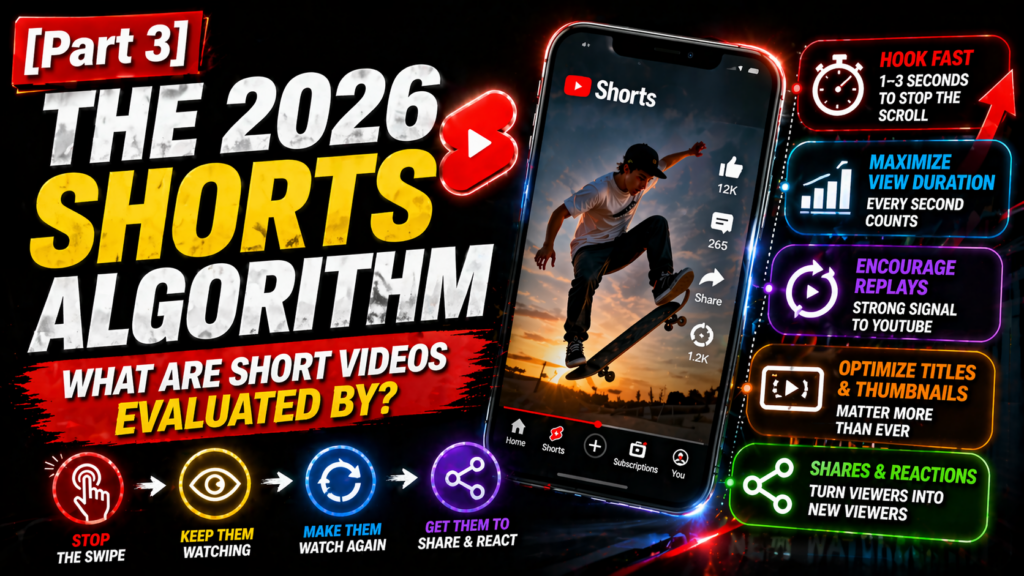
In Part 1, we established that the core purpose of the YouTube algorithm is
to help viewers find the videos they want and leave them satisfied after watching.
In Part 2, we looked at the long-form algorithm through that lens.
So what about Shorts?
Shorts still operate inside the recommendation system, but the center of gravity is different from long-form.
YouTube officially explains that the Shorts Feed is personalized by predicting what a viewer is likely to want to watch next. It also says that the broader recommendation system looks at multiple signals together, including watch history, search history, likes and dislikes, “not interested” signals, and satisfaction surveys.
In other words, Shorts do not spread by luck.
A better interpretation is that they move based on who stopped, who kept watching, and who reacted.
In this article, I will organize the factors that actually matter when evaluating Shorts.
Why Shorts Must Be Understood Differently From Long-Form
Long-form is a format that asks viewers to invest more time.
That is why deep satisfaction matters there.
Shorts, on the other hand, are much shorter, and the action of swiping to the next video happens extremely fast.
So Shorts are fundamentally more about the power to make someone stop and the power to create satisfaction in a very short amount of time.
YouTube itself explains in its Shorts creation guidance that creators need to grab attention within the first few seconds to stop people from scrolling. It also notes that although Shorts are still heavily consumed inside the feed, titles, descriptions, hashtags, and the overall appearance of the channel can also affect discovery and response.
My interpretation is that if long-form is a game of creating a reason to stay for a long time,
then Shorts are closer to a game of creating an immediate reason not to swipe away.
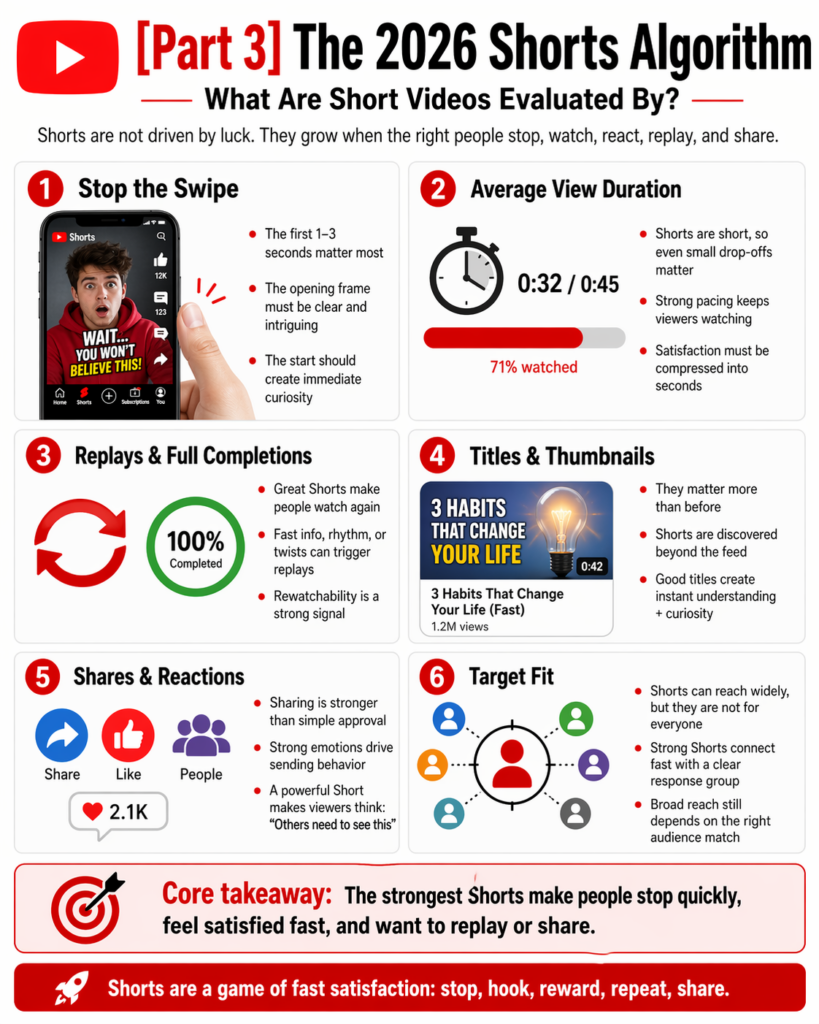
1. The First Thing to Look At: Did It Stop the Swipe?
The first gate in Shorts is simple:
Did the viewer swipe past, or did they stop?
YouTube’s official documents explain that the Shorts Feed is personalized, but they do not formally present a metric such as “view-to-swipe ratio” as a detailed creator-facing formula. Still, because YouTube clearly says that the first few seconds are critically important, it is natural to interpret this opening window as a major practical decision point.
Put simply, this is what it means:
- If the first screen does not catch the eye, people swipe away.
- If the first line is weak, people swipe away.
- If the first movement feels ordinary, people swipe away.
- If people do not immediately understand what the video is, they swipe away.
In Shorts, the first 1 to 3 seconds effectively function as a thumbnail too.
So the first scene should not just be visually nice. It needs to be immediately understandable and immediately intriguing.
In practice, Shorts that get past this first gate usually share a few traits:
- The situation is understandable from the very first frame
- The opening line creates a question or tension
- The screen is visually clear enough to stop attention immediately
- The next shot becomes instantly interesting
In other words, the beginning of a Short is not an introduction.
It is stopping power.
2. Average View Duration: A More Sensitive Metric Because Shorts Are Short
The second major factor in Shorts is
how long the video actually makes people watch.
YouTube explains that its recommendation systems do not work through raw exposure alone, but through actual viewer behavior and satisfaction signals. Shorts exist inside that same framework.
This is where Shorts differ from long-form.
Because Shorts are short,
even a small drop in retention can create a much bigger performance gap.
For example, long-form videos may still recover even if the middle becomes a bit loose.
But in Shorts, if the pacing weakens within 10 seconds, people often swipe away almost immediately.
That is why, in Shorts, average view duration is not just a useful reference metric.
It is closer to a core clue that tells you whether the structure of the content itself was right or wrong.
In my interpretation, when average view duration is high in Shorts, it usually means one or more of these things:
- The pacing was appropriate
- The expectation matched the actual content
- The visual changes did not become boring
- The ending or payoff was clear
- The video delivered emotional or informational satisfaction in a short amount of time
On the other hand, if average view duration is low, hidden problems often include things like:
- The beginning is strong, but the middle feels empty
- The title or opening shot makes a promise that collapses too quickly
- The pacing feels awkward
- There is no payoff at the end
- The viewer is given no reason to keep going
So Shorts are not an easier format because they are short.
If anything, they are a stricter format because satisfaction has to be compressed into a very short amount of time.
3. Replays and Full Completions: Especially Strong Signals in Shorts
Starting March 31, 2025, YouTube changed how Shorts views are counted so that each time a Short starts or replays, it can count as a view. This better reflects the actual way Shorts are consumed.
That update may look like a simple change in counting, but it offers an important clue for interpretation.
Shorts have always been a format where the strongest videos often do more than get watched once.
They make people keep watching or watch again.
The view-counting method was adjusted to better fit that pattern of consumption.
In practical terms, strong Shorts often do things like this:
- Make people want to check the ending again
- Move so quickly that people watch a second time to catch everything
- Encourage replay through rhythm or music
- Make viewers want to revisit the twist
- Get watched again before being saved or shared
So in Shorts, it is not just completion that matters.
A very strong weapon is a structure that naturally encourages repeat viewing.
That does not mean you should make the video confusing on purpose or pack it with forced speed.
The real point is simpler:
There should be a reason the shortness of the video makes people want to watch again.
4. Titles and Thumbnails: Much More Important Than Before
A lot of people still think that titles and thumbnails do not matter much for Shorts,
because Shorts are consumed inside a swipe feed.
But that is no longer the best way to see it.
YouTube’s official recommendation materials explain that Shorts are consumed in the Shorts Feed,
but also make it clear that recommendations are personalized across the home page, channel pages, and other entry points. Shorts creation guidance also advises creators to manage titles, descriptions, hashtags, thumbnail optimization, and overall channel presentation together.
That means this:
Shorts no longer live only inside the swipe feed.
A more realistic view is that they now exist across home, channel pages, recommendations, search, and related-video contexts too.
That is why titles and thumbnails now play clear roles:
- They create clicks outside the feed
- They clarify what the viewer should expect
- They shape the overall impression of the channel
- They connect Shorts to long-form videos or other Shorts
Still, titles and thumbnails for Shorts should work a little differently than they do for long-form.
Long-form leans more toward explanation and promise.
Shorts lean more toward instant understanding plus instant curiosity.
A strong Shorts title usually has qualities like these:
- You understand the situation immediately
- You immediately feel why it is worth watching
- It compresses the core emotion of the short video into a few words
5. Shares and Reactions: It Has to Go Beyond “I Liked It”
YouTube officially explains that explicit reactions such as likes, dislikes, “not interested,” and surveys are used as signals in the recommendation system.
In Shorts, among these reactions,
shareability often becomes especially important.
Why?
Because Shorts are short,
which makes them naturally easier to send to other people.
In practice, Shorts that get shared a lot usually have one or more of these traits:
- They contain a line that triggers a reaction
- They feel relatable enough to send to a friend
- They deliver strong informational value in a short time
- They carry highly contagious emotions like surprise, humor, anger, or comfort
- They make the viewer feel, “I want to send this instead of explaining it myself”
So Shorts become stronger when they go beyond likes
and create the feeling of:
“Other people need to see this too.”
From YouTube’s point of view, that is also a strong signal,
because it can bring new viewers into the platform.
6. Shorts Are Built for Broad Reach, But They Are Not for Everyone
Shorts have more potential than long-form to spread broadly.
But that does not mean they work for absolutely everyone.
YouTube officially explains that the recommendation system suggests content by comparing a user’s viewing habits with the behavior of similar viewer groups.
So even Shorts are ultimately dependent on target fit.
On the surface, Shorts may look broad and mass-friendly.
But in reality, the strongest Shorts usually have a very clear reaction group behind them:
- People who are sensitive to a certain emotion
- People who are interested in a certain topic
- People who want a certain problem solved quickly
- People who like a certain tone, rhythm, or way of speaking
That is why the core of Shorts strategy is not trying to make
“a video that works for everyone.”
It is trying to make
a video that quickly grabs the people who are most likely to react.
In that sense, Shorts are also a target game.
They simply hit the target in a faster and shorter way than long-form.
What You Should Actually Focus On in Shorts
If I turn everything above into practical action, it comes down to this:
1. You must create a reason to stop within the first 1 to 3 seconds
Stopping power comes before explanation.
2. The middle must not go soft
Because Shorts are short, even a small moment of boredom can cause an immediate swipe.
3. There must be a payoff at the end
People who stay until the end should be left with at least one of these: information, humor, surprise, or emotional resonance.
4. You should design for repeat viewing
If there is a built-in reason to watch again, the Short becomes stronger.
5. Titles and thumbnails matter too
Shorts can no longer ignore entry points outside the feed.
6. You need to create shareable emotion
That creates stronger spread than likes alone.
If I Had to Summarize the Shorts Algorithm in One Sentence
The kind of Short that YouTube seems to evaluate most strongly is:
a video that makes people stop, satisfies them in a short amount of time, and makes them want to watch again or send it to someone else.
That is why Shorts strategy is simple:
- Make them stop early
- Pull them in quickly
- Give them a payoff at the end
- Leave behind a reason to replay or share
The more this structure works,
the stronger the Short becomes.
Conclusion
If you look at Shorts the same way you look at long-form,
your interpretation will keep going wrong.
Long-form is a game of deep satisfaction.
Shorts are a game of fast satisfaction.
But they still share the same foundation.
What YouTube ultimately wants in both cases is the same:
to show viewers content they want to see, and make them feel satisfied after watching it.
Shorts simply compress that process into a much shorter and faster demand.
So the most important thing in Shorts is not:
- making the video look pretty,
- chasing trends blindly, or
- simply cutting it short.
The most important thing is this:
creating a reason not to swipe, a reason to watch until the end, and a reason to react after watching.
That is the closest interpretation of the 2026 Shorts algorithm.
One-Line Summary
The Shorts algorithm is moving toward rewarding videos that
make people stop within the first few seconds, satisfy them quickly, and generate replay or sharing behavior.
Next, read Part 4 to avoid the most common YouTube algorithm myths.