
Instagram Is No Longer Just a Photo App
At some point, Instagram became a Reels-first platform.
In the past, if you uploaded a good photo, people could discover your account.
They would see your lifestyle, your taste, your personality, and maybe become interested in you.
But now, things are different.
Even if you upload a beautiful photo, it often feels like nobody sees it.
Your lifestyle, your expertise, and even your personal story now need to be turned into Reels if you want them to reach new people.
This does not mean photos are completely dead.
Photos, carousels, and Stories still matter.
But if we are talking about reaching people who do not already follow you, Reels are now the center of Instagram.
Instagram is no longer just an app for posting beautiful photos.
Instagram has become a platform that captures short bursts of attention and spreads that attention through relationships.
Why Instagram Pushes Reels
Reels launched in August 2020.
Since around 2021, Instagram has been actively pushing Reels.
The reason is simple.
People started spending more time watching short-form videos.
TikTok took people’s attention.
YouTube responded with Shorts.
Instagram could no longer survive as a photo-first platform.
The platform war is ultimately a war for time.
Where do people spend their time?
Which app do they keep open longer?
What type of content do they watch?
What type of content do they send to other people?
To compete in that war, Instagram changed its structure around Reels.
That means the most important question is no longer:
“Is my photo beautiful?”
The real questions are:
“Does this content make people stop scrolling?”
“Does this content give people a reason to send it to someone else?”
If your content cannot answer those two questions, it will be difficult to get strong reach on Instagram.
The Main Goal of the Instagram Algorithm in 2026
In my view, the core goal of the Instagram algorithm in 2026 is simple:
Make people watch until the end and make them send it to someone else.
That one sentence explains almost everything.
Instagram wants users to stay inside the app for as long as possible.
And it also wants those users to bring other people back into the app.
So Instagram tends to reward two types of content:
Content that makes people watch longer.
Content that makes people share it with others.
When people watch longer, Instagram gains more session time.
When people share content, Instagram gets another user to come back into the app.
For example, imagine I watch a Reel and send it to a friend through DM.
My friend opens Instagram to watch it.
Then my friend replies to me.
We start talking about the video.
That whole process increases the time we both spend inside Instagram.
From the platform’s perspective, that is a very powerful behavior.
This is why sharing is much stronger than simply pressing the like button.
A like usually ends with one person.
A share brings another person into the platform.
The Instagram Algorithm Watches Human Behavior
Many people think the algorithm is complicated.
But when I look at algorithms, I think we need to look at human behavior before looking at technology.
Instagram measures what people do.
Did they stop scrolling?
Did they keep watching?
Did they read the comments?
Did they write a comment?
Did they save the post?
Did they follow the account?
Did they send the content to someone else?
Every action is a signal.
And those signals can be interpreted like this:
If someone stops scrolling, it means the content caught their attention.
If someone watches for a long time, it means the content held their attention.
If someone reads the comments, it means they are curious about how other people reacted.
If someone saves the content, it means they think it has value for later.
If someone follows the account, it means they want to see more from that creator.
If someone shares the content, it means they believe the content has value inside a relationship.
So the algorithm is not just looking at numbers.
The algorithm uses human behavior to judge how valuable a piece of content is.
The Two Actions Instagram Wants Most
In the end, Instagram wants two main actions.
First, it wants people to watch longer.
Second, it wants people to share.
A video that keeps people watching holds users inside the platform.
A video that gets shared is even more powerful.
A share reaches beyond one user and brings another person back into Instagram.
So the best type of video for Instagram looks like this:
Someone stops scrolling.
They watch until the end.
They read the comments.
They save it.
Then they send it to someone else.
That kind of video creates almost every behavior Instagram wants.
On the other hand, even if a video is beautiful and well-produced, it does not matter much if people skip it immediately.
Instagram does not reward content simply because it looks good.
Instagram rewards content that makes people react.
This difference is important.
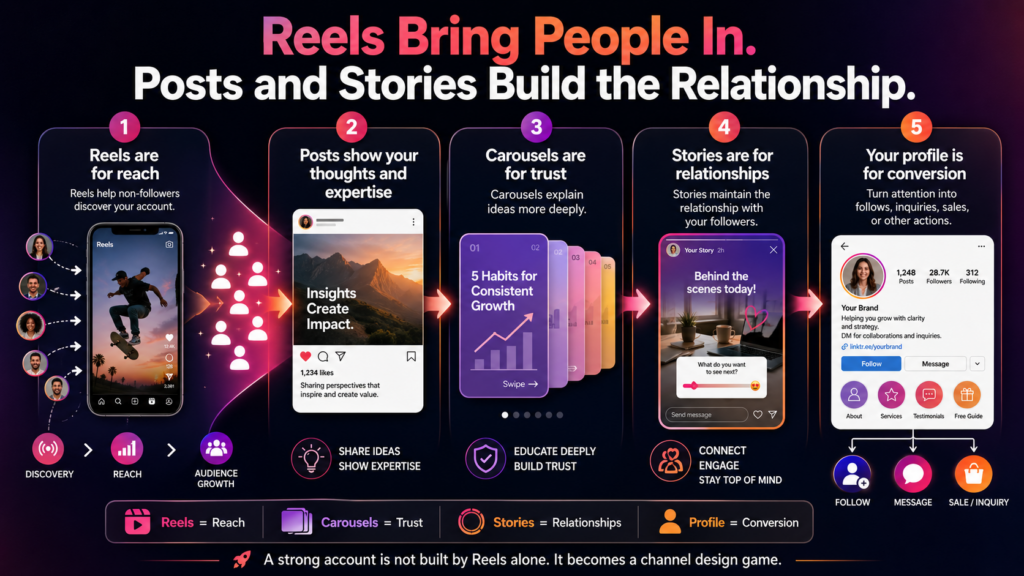
Reels Bring People In. Posts and Stories Build the Relationship.
This does not mean only Reels matter.
Reels mainly function as an entry point.
Reels help people who do not know you discover your account.
They introduce your content to non-followers.
That makes Reels the front door of account growth.
But after someone follows you, posts, carousels, and Stories become important.
Posts show your thoughts and your expertise.
Carousels explain ideas more deeply.
Stories maintain the relationship with your followers.
So I think the Instagram structure should be understood like this:
Reels are for reach.
Carousels are for trust.
Stories are for relationships.
Your profile is for conversion.
A strong account is not built by Reels alone.
You use Reels to bring people in.
You use posts and carousels to build trust.
You use Stories to maintain connection.
You use your profile to convert attention into follows, inquiries, sales, or other actions.
Once you understand this structure, Instagram is no longer just a reach game.
It becomes a channel design game.
Why Photos Became Weaker but Still Matter
You could say that the photo era is over.
More accurately, the era where photos alone could easily bring new people to your account is mostly over.
But that does not mean photos and posts are useless.
Photos help your existing followers understand you.
Stories show your daily life and thoughts.
Carousels organize information and create persuasion.
In other words, photos and posts are no longer the strongest tools for discovery.
They are stronger as tools for relationship maintenance.
Before, photos could bring people to your account.
Now, Reels usually do that job.
Before, photos created the first impression.
Now, Reels often create the first impression.
But after someone follows you, your posts and Stories help that person understand you more deeply.
So photos are not dead.
Their role has changed.
The Difference Between Instagram Reels and YouTube Shorts
Instagram Reels and YouTube Shorts look similar.
Both are short videos.
Both are consumed quickly.
Both can be recommended by algorithms.
But the psychology of the two platforms is different.
YouTube Shorts are closer to light content consumption.
People watch a Short, swipe to the next one, then swipe again.
Even when they see a useful informational Short, it often does not lead directly to a subscription.
Why?
Because YouTube has long-form videos.
People often think:
“This information is useful, but if I want the deeper version, I should watch a longer video.”
That makes it harder to build subscribers with Shorts alone, especially for educational or informational content.
Instagram is different.
On Instagram, Reels are a major path for account discovery.
Someone watches your Reel.
If they like it, they visit your profile.
They look at your other posts.
They may watch your Stories.
Then they decide whether to follow you.
So Instagram Reels are not just about content consumption.
They are more closely connected to account discovery and relationship building.
YouTube Shorts are closer to quick consumption.
Instagram Reels are closer to discovering a person, a brand, or an account.
This difference matters.
Instagram Is a Relationship-Based Platform
Instagram should not be seen only as a video platform.
Instagram is a relationship-based platform.
People use Instagram to see their friends, partners, family members, favorite influencers, and brands they care about.
That is why strong Instagram content is not just content with good information.
Strong Instagram content gives people a reason to send it to someone else.
A video you want to send to a friend.
A video you want to show your partner.
A video you want to drop into a family group chat.
A video you want to send to a coworker.
A video you want to share with someone who has the same problem as you.
That kind of content is powerful.
In the end, shareable content on Instagram strengthens relationships.
The strongest content makes people say:
“Hey, look at this.”
That is what makes Instagram different from YouTube.
YouTube is closer to a platform that tries to satisfy viewers and keep them watching.
Instagram is closer to a platform that makes people stay in the app through daily interaction and sharing.
That is why Instagram content needs not only informational value, but also relational value.
Summary of Part 1
To understand the Instagram algorithm in 2026, we need to look at the platform’s purpose before looking at technical tricks.
Instagram is no longer a photo-first app.
It has become a platform where Reels help you reach new people, while posts and Stories help you maintain relationships with existing followers.
The core goal of the algorithm is simple:
Make people watch until the end.
Make people send it to someone else.
Longer watch time increases time spent in the app.
Sharing brings other people back into the app.
That is why Instagram does not simply reward beautiful content.
It rewards content that makes people stop, watch, react, save, follow, and share.
Reels are for reach.
Carousels are for trust.
Stories are for relationships.
Profiles are for conversion.
Once you understand this structure, your Instagram strategy becomes much clearer.
The real starting point is not:
“How do I beat the algorithm?”
The real questions are:
“Why would someone stop and watch my content?”
“Why would someone send my content to another person?”
If your content can answer those two questions, it has a much better chance of surviving inside the Instagram algorithm.
Next, read Part 2 to learn the seven Instagram algorithm signals that actually matter.