
Before reading this, you may want to read Part 3 on how Shorts are evaluated.
There are certain ideas about YouTube that seem to survive forever.
“Posting every day helps the algorithm.”
“You need to use the right tags to go viral.”
“Small channels are at a disadvantage.”
“Posting Shorts will kill your long-form videos.”
Some of these statements sound believable in certain situations.
But the problem is this:
What sounds plausible is not always what is actually true.
According to YouTube’s official explanation, the goal of the recommendation system is very clear:
To show each viewer the most relevant content at that moment.
It also emphasizes that performance is not judged by views alone, but by whether viewers actually watch, enjoy, and feel satisfied.
When you look at it from this perspective, many common beliefs about the YouTube algorithm are either exaggerated or simply wrong.
In this article, we’ll break down the 10 most common misconceptions.
1. “You Have to Upload Every Day”
This is an exaggeration.
YouTube explicitly states that there is no minimum upload frequency required to succeed.
Posting every day does increase exposure opportunities.
But that is increasing chances, not a reward from the algorithm.
What actually matters more is:
- Do viewers come back to your channel?
- Does satisfaction build over time?
- Does your channel create expectations?
In short, consistency and quality matter more than frequency.
A channel that uploads once a week but delivers clear value
can outperform a daily channel with average content.
2. “Long Videos Always Perform Better”
This is also a misconception.
YouTube evaluates performance based on whether viewers enjoyed and were satisfied, not just the length of the video.
So:
- A 5-minute video that delivers full value is strong.
- A 20-minute video that feels empty is weak.
Many people focus only on total watch time.
But in reality, unnecessarily long videos can reduce satisfaction.
The key is not length.
It is whether the video is properly designed for its topic.
3. “The First 48 Hours Decide Everything”
This is only half true.
The first 48 hours are important because they help the algorithm understand who the video is for.
But YouTube is not a system that locks a video’s fate permanently after a short period.
If a video remains relevant, it can gain traction later through:
- Search
- Suggested videos
- Long-term discovery
That is why evergreen content can grow over weeks or even months.
The danger of this myth is clear:
People give up on videos too early.
4. “Small Channels Are at a Disadvantage”
This is an oversimplification.
YouTube prioritizes relevance to the viewer, not channel size.
Subscriber count does not equal active audience.
Even large channels can have many inactive subscribers.
What matters more is:
How well your video matches the current viewer.
Large channels may have advantages in brand and initial traffic,
but the algorithm does not inherently suppress small channels.
5. “Tags Are the Secret to Views”
This is mostly false.
YouTube clearly states that:
Titles and thumbnails are far more important than tags.
Tags mainly help with:
- Misspellings
- Minor keyword variations
They do not significantly boost discovery.
What actually matters:
- Does your title create the right expectation?
- Does your thumbnail attract the right click?
- Does your content fulfill that expectation?
Tags are a supporting element, not the main driver.
6. “Posting at the Right Time Boosts the Algorithm”
Another common myth.
YouTube explains that upload time itself does not determine long-term performance.
However:
- Posting when your audience is active can improve early traction.
But the real factor is:
The quality of early viewers, not the time itself.
7. “Posting Shorts Hurts Long-Form Content”
This is not true.
YouTube clearly states that Shorts performance does not negatively affect long-form recommendations.
In fact, Shorts can help:
- Discover new audiences
- Expand reach
However, there is one practical caution:
If your Shorts and long-form content are too different in tone or audience,
your viewer base may become fragmented.
So the issue is not Shorts itself,
but lack of alignment between formats.
8. “Taking a Break Hurts Your Channel”
This is exaggerated.
YouTube does not officially penalize inactive channels.
What actually happens is:
- Audience expectations fade
- Return patterns weaken
- Channel memory decreases
So performance may drop, but not because of a penalty.
It is more about broken rhythm and relationship.
9. “Uploading New Videos Kills Old Ones”
This is too simplistic.
YouTube allows older videos to keep performing if they remain valuable.
In fact:
- Evergreen videos can grow over time
- Search-based videos often improve with age
- New uploads can even revive older content
YouTube is not a “test once and discard” system.
10. “You Should Always Share Your Video Widely at the Start”
This can actually be harmful.
YouTube uses early viewer data to understand:
Who the content is for.
If you share your video to people who are not your target audience:
- They may click but leave quickly
- They may not watch fully
- They may not engage meaningfully
This can confuse the algorithm.
So early on, it is not about more people.
It is about the right people.
What Actually Matters to YouTube
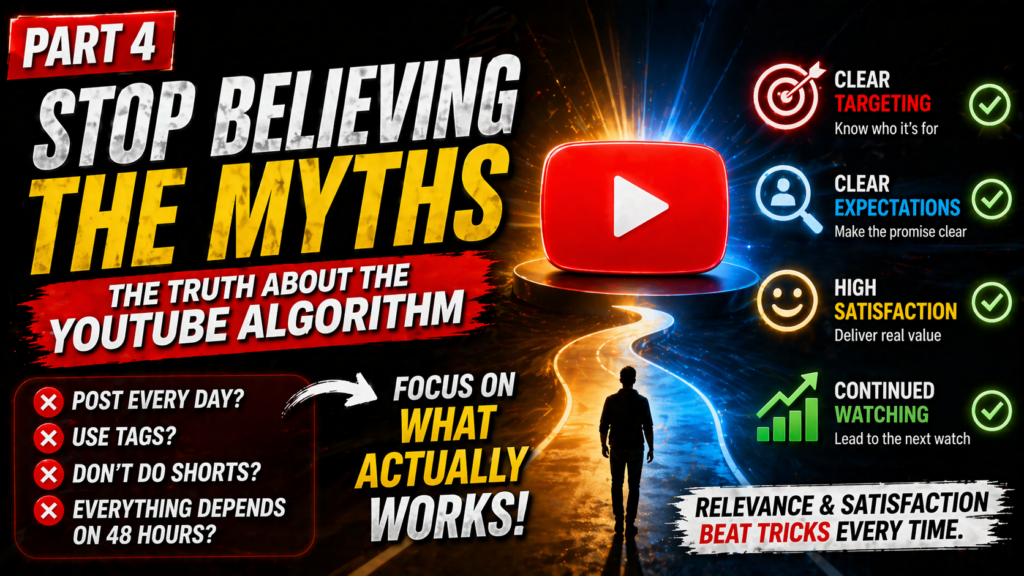
When you remove all the misconceptions, what remains is simple:
YouTube is not a platform that rewards:
- Frequency
- Tags
- Timing tricks
Instead, it focuses on:
Showing the most relevant and satisfying content to each viewer at the right moment.
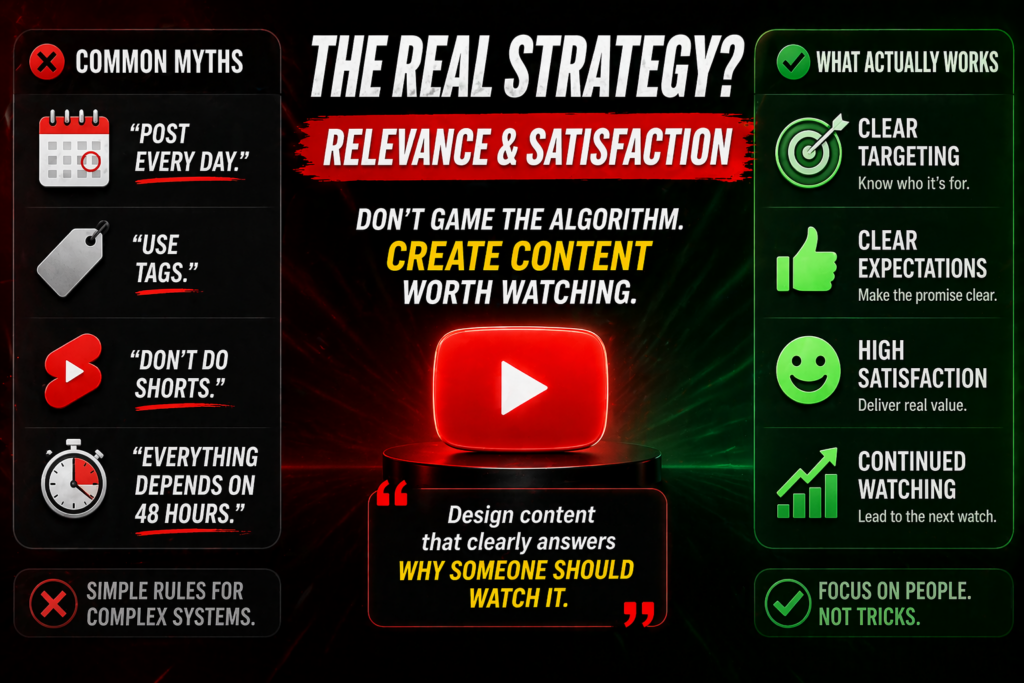
So the real strategy is not hacks.
It is:
- Clear targeting
- Clear expectations
- High satisfaction
- A structure that leads to continued watching
Conclusion
Misconceptions about the YouTube algorithm spread for a simple reason:
People want simple rules for complex systems.
“Post every day.”
“Use tags.”
“Don’t do Shorts.”
“Everything depends on 48 hours.”
These are easy to remember.
But the platform itself does not work that way.
If you follow YouTube’s official explanations, the direction is clear:
YouTube values relevance and satisfaction more than tricks.
So instead of trying to game the algorithm,
the better strategy is:
Design content that clearly answers why someone should watch it.
That is the most realistic way to work with the algorithm.
One-Line Summary
Most YouTube algorithm myths come from overvaluing surface factors like frequency, tags, and timing.
What actually matters is:
target fit, satisfaction, and the quality of viewer response.
Next, read Part 5 to understand why YouTube feels sharper in the multimodal era.