
In Part 1, I explained the real purpose of the YouTube algorithm.
As discussed in Part 1, the core purpose of the YouTube algorithm is simple:
to help viewers find the videos they want and leave them satisfied after watching.
So what matters most in long-form content?
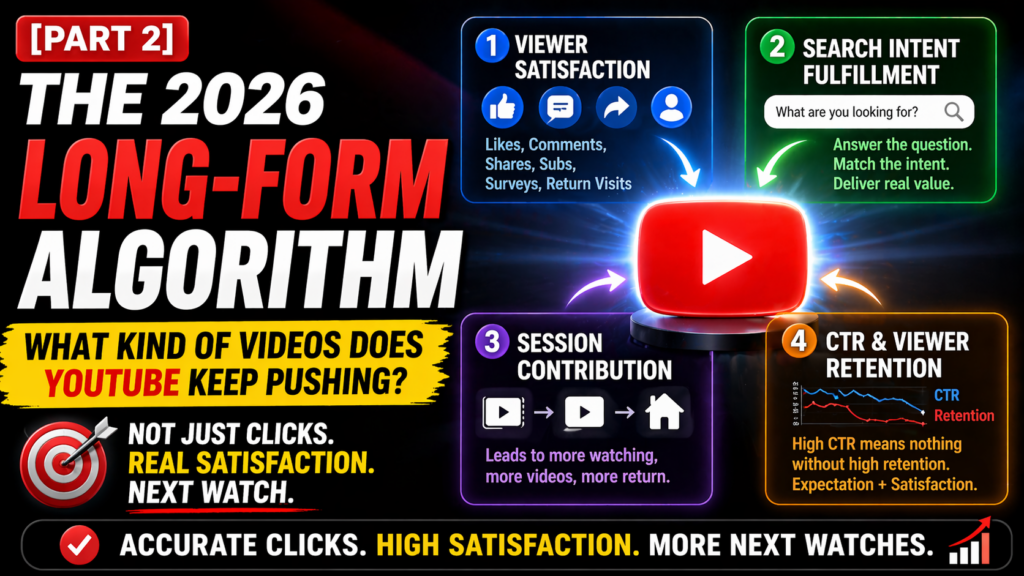
In my view, the long-form algorithm ultimately revolves around these four things:
- Viewer satisfaction
- Search intent fulfillment
- The ability to lead into the next watch
- Actual viewer response after the click
In this article, I will break down how YouTube seems to evaluate long-form videos through these four lenses.
Why Long-Form Has to Be Understood Differently From Shorts
Unlike Shorts, long-form content asks viewers to invest more time.
Because of that, from YouTube’s perspective, it cannot just care about “Did this video grab attention for a moment?”
It has to care more about “Was the time spent on this video actually worth it?”
That is why, in long-form, what matters is not simply the power to hold someone for a moment,
but rather the power to give them a reason to keep watching until the end.
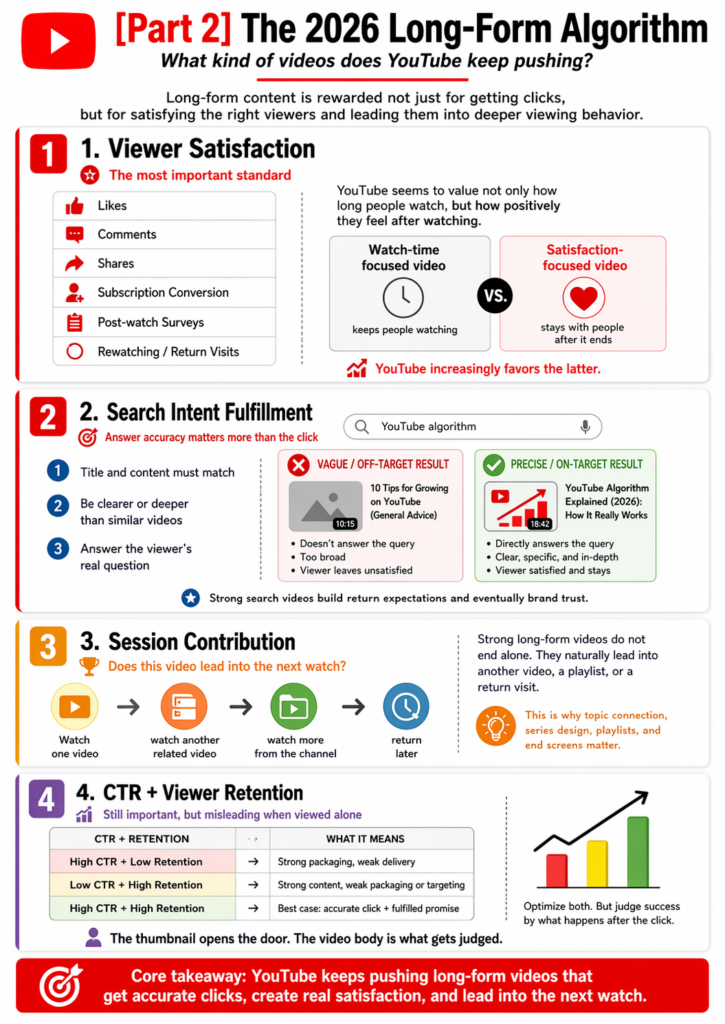
1. Viewer Satisfaction: The Most Important Standard
When people talk about YouTube, many immediately think of CTR or watch time.
But in practice, long-form seems to be judged much more heavily through the lens of long-term satisfaction.
That point matters a lot.
Because it suggests YouTube is not only asking,
“How long did this person watch?”
but also,
“Did this person feel positively about the experience after watching?”
From a practical point of view, the signals that seem closely tied to satisfaction in long-form are things like:
- Likes
- Comment quality and reaction
- Shares
- Subscription conversion
- Post-watch surveys
- Rewatching, continued viewing, and return visits to the channel
Of course, YouTube does not publicly reveal how much weight each of these signals carries.
But the overall direction seems clear:
A video that leaves viewers with a positive impression is stronger than a video that simply kept them watching for a while but felt empty afterward.
This is where many creators get confused.
The skill of increasing watch time and the skill of increasing satisfaction are not exactly the same.
- A watch-time-focused video is a video that drags people along.
- A satisfaction-focused video is a video that stays with people after it ends.
My interpretation is that YouTube is increasingly favoring the latter.
2. Search Intent Fulfillment: “Answer Accuracy” Matters More Than the Click
There is one area where long-form is especially powerful:
search.
This is where one thing becomes critically important:
the alignment between the search query and the actual substance of the video.
For example, if someone searches for “YouTube algorithm,”
but the video only has a convincing title while the real content is vague and abstract, satisfaction will drop.
On the other hand, if the title, thumbnail, opening, and main content all point in the same direction,
then the video is far more likely to fulfill search intent well.
In practical terms, this comes down to three things.
1) The title and the real content must match exactly
The promise made in the title must be delivered immediately in the content.
If the video feels off-track within the first 30 seconds, viewers begin to leave, and satisfaction drops.
2) Even on the same topic, the video must be clearer or deeper
The more crowded a topic becomes,
the more differentiation comes from structure, originality, examples, and specificity.
3) The video must answer the question the viewer actually has
A strong search-driven long-form video is not a video that simply dumps information.
It is a video that answers a question.
This is especially important for educational or knowledge-based channels.
Channels that consistently satisfy search intent gain something even more valuable than one-off views:
the expectation of a return visit.
Once viewers begin to feel,
“This channel gives me accurate answers to the questions I actually have,”
then something bigger than the algorithm starts to form.
That is when a brand begins to exist.
3. Session Contribution: Does This Video Lead Into the Next Watch?
A strong long-form video does not end by itself.
It naturally leads into the next video.
In practical terms, session contribution appears high when things like this happen:
- After watching my video, viewers keep watching more videos on a similar topic
- They continue into another video on my channel
- They become more deeply immersed in the subject itself
- They come back to my channel again later
YouTube does not directly provide creators with a metric called “session contribution score.”
So this is more of a working interpretation than an official label.
Still, the overall direction seems obvious:
YouTube has every reason to care about whether this video increases the likelihood of another watch happening next.
That is why long-form is not just about making one good video.
Topic connection, series structure, playlist design, and end-screen guidance all become genuinely important.
In other words, long-form is a format where you need to design both:
- the quality of one individual video, and
- the structure that leads viewers naturally into the next one.
4. CTR and Viewer Retention: Still Important, But Misleading When Viewed Alone
CTR is still important.
If the thumbnail and title do not get clicked, nothing begins in the first place.
But now, CTR alone can easily mislead people.
The more useful way to think about it is this:
High CTR + low retention
This usually means the packaging was strong, but the content did not live up to the expectation.
Low CTR + high retention
This usually means the content is actually solid, but the packaging, targeting, or discovery context is weak.
High CTR + high retention
This is the strongest combination.
It means the click was accurate, and the video itself fulfilled the promise.
The most important point here is simple:
CTR only makes sense when you look at it together with the quality of the click.
In the past, many people treated CTR as if “high clicks automatically mean the video is good.”
But that interpretation is now too simplistic.
My interpretation is that long-form now works like this:
the thumbnail opens the door, but the body of the video is what gets judged.
Opening the door is not enough.
The person who came in has to leave satisfied.
What Creators Should Actually Focus on in Long-Form
If I turn everything above into practical action, it comes down to this:
1. The title and thumbnail must make the expectation clear
It is more important to promise accurately than to bait aggressively.
2. The first 30 seconds must answer the viewer’s question
If a long-form video loses direction early, it is very hard to recover.
3. The main body should be designed for satisfaction, not just information volume
Explaining at length and explaining clearly are not the same thing.
4. One video should naturally lead into the next
Long-form becomes stronger when you think in terms of channel structure, not isolated uploads.
5. The target audience must be clear
Vague “for everyone” videos are likely to be weaker than content that clearly knows who it is for.
If I Had to Summarize the Long-Form Algorithm in One Sentence
The kind of long-form video YouTube keeps pushing is not simply a video that gets clicks.
It is a video that the right viewer clicked on and was genuinely satisfied with afterward.
That is why the core of long-form strategy is simple:
- not packaging more aggressively, but
- creating clearer expectations,
- delivering deeper satisfaction, and
- designing the video to lead naturally into the next watch
When those four things work together, long-form becomes powerful.
Conclusion
The first idea you need to let go of when trying to understand the 2026 long-form algorithm is this:
“YouTube just pushes whatever gets the most clicks.”
That is no longer the best way to see it.
A more accurate interpretation is that YouTube is increasingly built to find videos that viewers are likely to want, likely to enjoy, and likely to feel satisfied with over the long run.
So in long-form, what matters most comes down to one thing:
delivering the answer the viewer expected, at the density they expected, in a way that feels satisfying all the way through.
That is the closest interpretation of the long-form algorithm’s core logic.
One-Line Summary
The long-form algorithm is moving toward rewarding
accurate clicks, high satisfaction, and the power to lead into the next watch
more than simple view-count tricks.
Next, read Part 3 to learn how the 2026 YouTube Shorts algorithm evaluates short videos.