
In Part 4, we removed the most common misunderstandings about the YouTube algorithm.
If you’ve been on YouTube for a long time, you’ve probably heard people say this more and more:
“The algorithm feels sharper than before.”
“Average videos don’t work anymore.”
“It only hits the exact right audience now.”
This feeling is actually quite accurate.
But what matters is not just sensing the change — it’s understanding why it’s happening.
According to YouTube’s official explanations, the core principle of the recommendation system is clear:
It continuously tries to find videos viewers want to watch and predict whether those videos will deliver real value.
This process considers:
- Watch history
- Search behavior
- Likes, shares, comments, “not interested,” surveys
- Behavior patterns of similar viewers
In other words, YouTube is shifting toward:
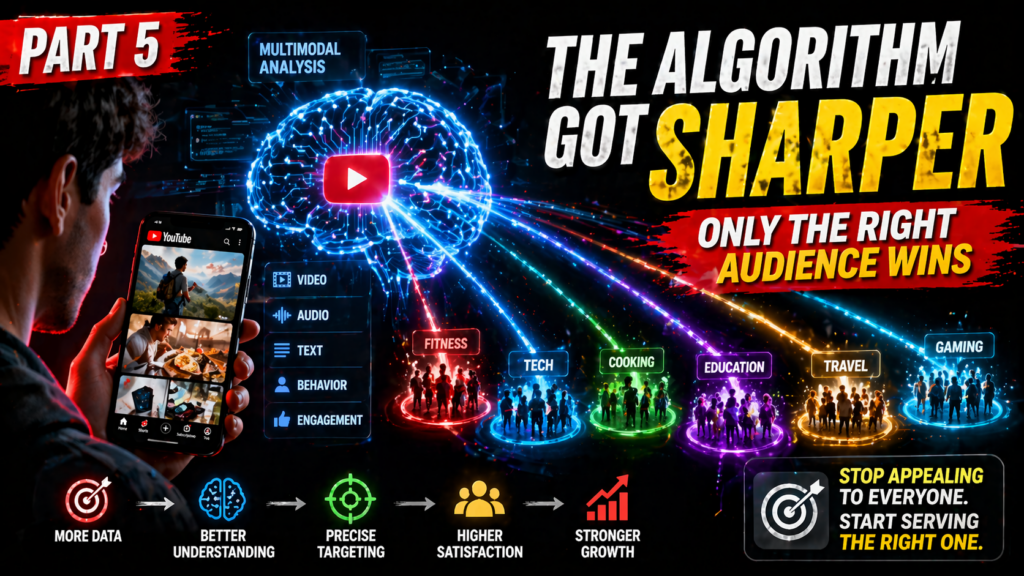
“Who will be satisfied by this video?” rather than “How many people will watch it?”
1. YouTube Was Never Truly a “Broadcast to Everyone” Platform
Many people still think YouTube works like this:
“If a video is good, it spreads to everyone.”
That does happen sometimes — but it’s not the core system.
YouTube clearly states that recommendations are personalized, especially on the Home and Up Next feeds.
This personalization is not shallow.
It looks at:
- What you watch for a long time
- What you ignore
- What you search
- What you repeatedly react to
So YouTube has always been closer to:
a system serving countless micro-interest groups, not one mass audience.
The difference now is simple:
The precision has dramatically increased.
2. Why It Feels Sharper: Personalization Became Stronger
A major clue comes from YouTube’s discovery system changes.
In July 2025, YouTube removed the Trending page and shifted toward category-based discovery.
This change is symbolic.
- The old system = “One big stage everyone sees”
- The new system = Interest-based, contextual discovery
This means YouTube is evolving into:
A platform that connects satisfaction at the interest level, not at the mass level.
That’s why creators feel the algorithm is “sharper.”
3. YouTube Now Prioritizes Viewer Fit Over Raw Views
YouTube repeatedly uses phrases like:
- “Videos viewers want to watch”
- “Content viewers are likely to enjoy”
- “Videos that provide value”
- “What similar viewers are watching”
These all point in one direction:
YouTube is not just chasing views — it is predicting fit.
Because of this:
- Vague content struggles more
- Unclear targeting weakens recommendations
- Mismatched expectations reduce performance
So when people say “the algorithm got stricter,”
a more accurate interpretation is:
It got better at evaluating relevance.
4. Multimodal Analysis: Not Fully Confirmed, But Direction Is Clear
A common question:
“Does YouTube now understand the video itself more deeply?”
We need to separate facts from interpretation.
Officially confirmed
YouTube uses:
- Watch behavior
- Search behavior
- Engagement signals
- Topic and format preferences
- Similar audience patterns
Industry interpretation
There is strong belief that YouTube increasingly analyzes:
- Visual content
- Speech
- Subtitles
- Editing patterns
- Tone and pacing
This suggests a shift toward:
Understanding the content itself, not just metadata.
While YouTube hasn’t fully disclosed technical details,
the direction is consistent with its official focus on:
relevance, satisfaction, and viewer alignment.
5. Titles, Descriptions, and Tags Have Changed Roles
This shift changes how we use metadata.
YouTube clearly states:
- Titles and thumbnails matter far more than tags
- Tags are mostly for misspellings and minor variations
So practically:
Title
Entry point for search and clicks
→ Must clearly promise value
Description
Supporting context
→ Helps understanding, not a replacement for content
Tags
Minor support
→ Not a core growth strategy
The old strategy of “stuffing keywords” no longer works.
Now the key is:
Clear expectation → Real delivery
6. Why Niche Channels Became Stronger
Many creators feel niche channels perform better now.
This makes sense.
YouTube recommends based on:
- Viewer history
- Behavior patterns
- Similar audience groups
In this system, clarity wins over breadth.
A strong niche channel clearly defines:
- Who it’s for
- What it covers
- What satisfaction it delivers
- Which audience it fits
For the algorithm, this is easier to process and recommend.
So the truth is not:
“Small topics are better.”
It’s:
Clear audience fit is more powerful.
7. From “Broadcasting” to “Precision Targeting”
This is the most important shift.
YouTube becoming “sharper” means:
Broad messaging is weaker than precise messaging.
This applies to both long-form and Shorts:
- Long-form → deep satisfaction
- Shorts → fast satisfaction
But both require:
Clarity of who and why
So the better approach is:
- Don’t target everyone
- Find who strongly cares
- Match their expectations
- Deliver real satisfaction
8. What Creators Must Change
If the platform became sharper, creators must become clearer.
Key shifts:
- Stronger target definition
- More consistent topics
- Higher-quality clicks (not just more clicks)
- Focus on satisfaction
- Build content chains (next watch design)
The advantage now goes to:
Creators who precisely design satisfaction for a specific audience.
9. YouTube Is Becoming a “Satisfaction Platform”
This is the final insight.
YouTube is still a mass platform.
Views and virality still matter.
But at the system level, it is becoming:
A platform that connects viewers with content they are most likely to enjoy.
So the real questions become:
- Who will love this video?
- Why will they stop scrolling?
- What will they gain after watching?
- Will they come back again?
Answer these well, and the algorithm becomes an ally.
Conclusion
Yes, YouTube feels sharper now.
But that doesn’t mean it’s unpredictable.
It means:
It is more precise.
The platform now revolves around:
- Personalization
- Topic relevance
- Viewer satisfaction
- Quality of engagement
Because of this:
- Vague channels weaken
- Clear channels strengthen
The role of multimodal analysis is not fully disclosed,
but the direction is clear:
Better understanding of content + stronger viewer matching
So the core strategy becomes simple:
Don’t broadcast widely — target precisely.
One-Line Summary
YouTube feels sharper because personalization and satisfaction signals have become stronger —
so clear audience fit now matters more than broad appeal.
If you want to understand the whole YouTube algorithm series from the beginning, start with Part 1.